
Cold Open: Missing The Target
When reform signals get lost in mixed signals

I teach a class on crisis communications1 at Georgetown. Each week, we start with a ‘cold open’ segment to test our learnings against the headlines.
The semester just wrapped. But if I could convene a ‘where are they now?’ reunion, I’d start with Target.
In January, Target set out to forge a new path on DEI. As did many of its peers, of course.
Target, however, took the novel approach of saying it was “accelerating action” and so they could now phase out programs sooner rather than later.
Too cute by half? Sure. More importantly, after years as a DEI champion, Target’s shift was too abrupt to process. Whiplash led to backlash and then boycotts.
As foot traffic in stores fell, the company went quiet, generally referring back to old statements at most. In mid-March, we returned to Target in a cold open:
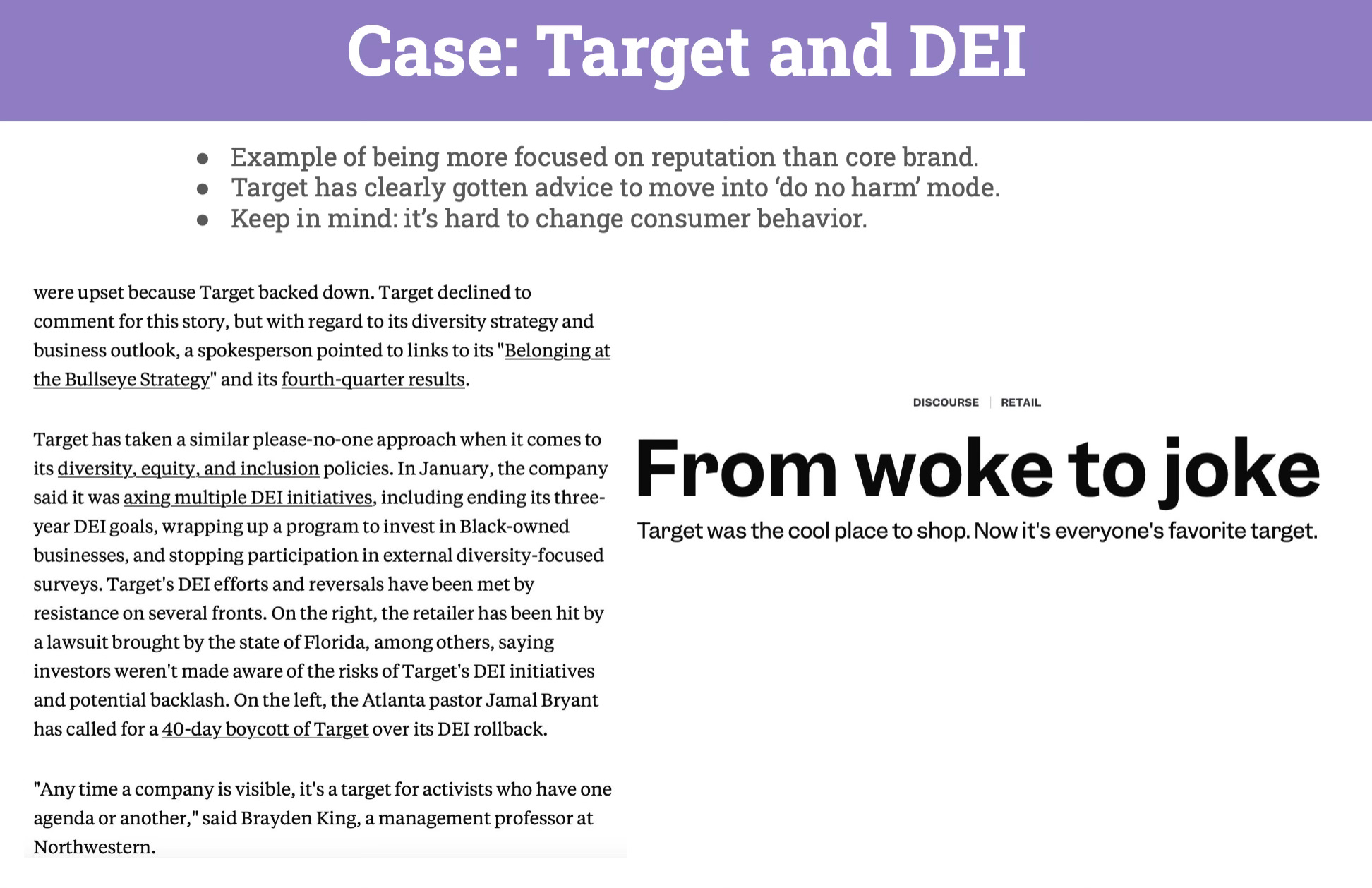
One of our “rule #1’s in class is to ‘do no *additional* harm.” “Don’t say anything new” or “don’t give it more oxygen” can be good counsel in moderation–or it can allow others to fill the glass (more on that next week.)
By April, a shift: Target was meeting with boycott leaders. It was clear something was changing, but what?
An answer–or an attempt at an answer–came late last week in the form of an internal memo from Target’s CEO. This, too, was not unusual. The internal CEO letter has become a go-to tool for reputational repair. It can check a lot of boxes: part update, part values statement, part reset. When done well–and strategically leaked–it can serve as a sturdy bridge to the next phase of recovery.
But after a few read-throughs, I’m not sure this one gets all the way across. I’m not even sure it checks any of the boxes it’s aiming for.
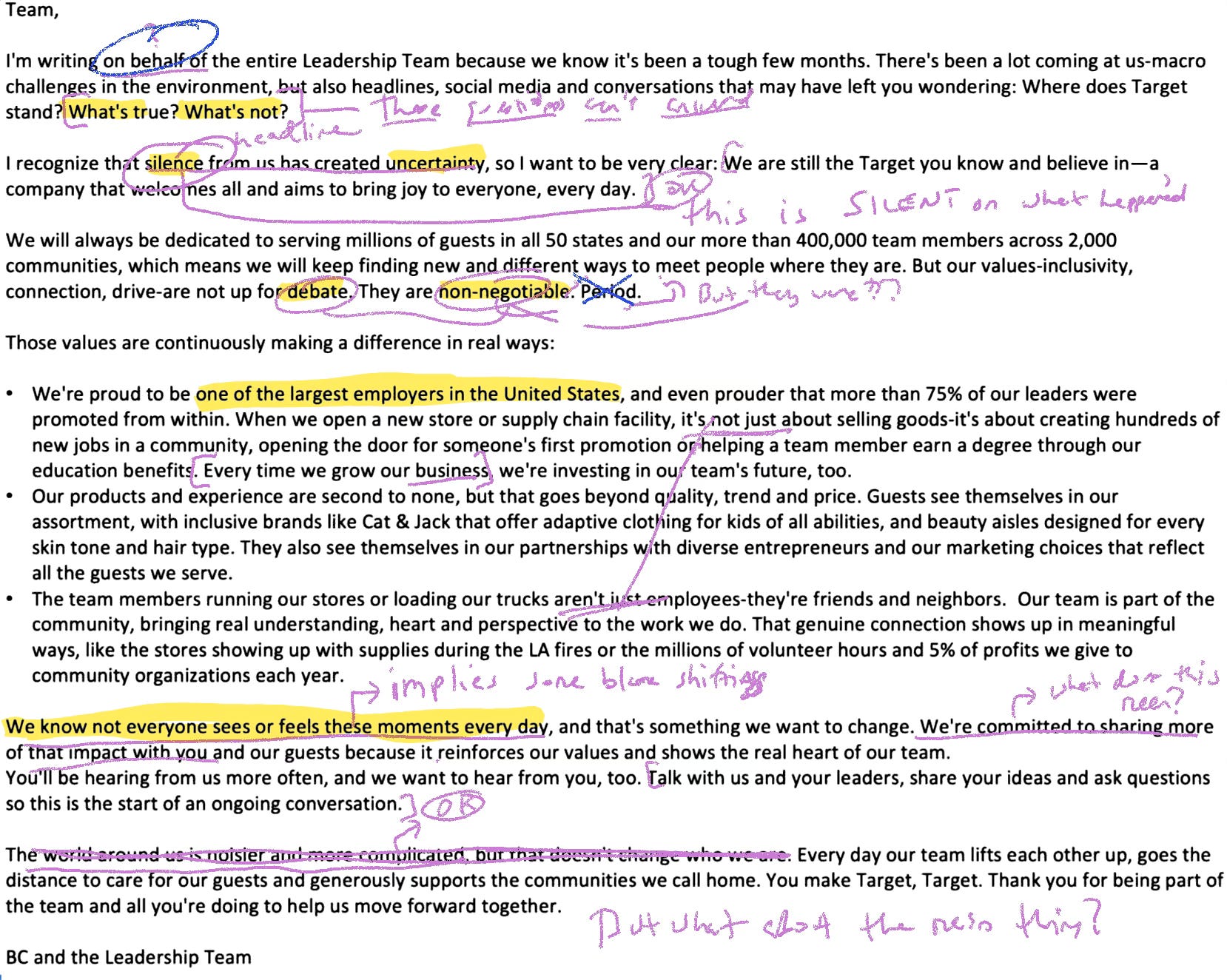
In class, we like to review statements line by line, so let’s do a bit of that here.
1. “I’m writing on behalf of the entire Leadership Team…”
CEO communiques are often effective because they are just that, from the top. Diluting the voice here sets a distant tone.
2. “Where does Target stand? What’s true? What’s not?”
Using framing questions like this can be a good device–assuming you answer them. Perhaps there was a previous version of this that more clearly did this, but you will not find those answers here. If anything, a reader could walk away with more questions than answers.
3. “I recognize that silence from us has created uncertainty…”
This is essentially the headline, largely because it’s the closest thing to an actual apology. What audiences want in moments like this is a clear sense of ownership. Here, the non-apology apology on behalf of ‘us’ contributes to perpetuating the problem because the memo is in fact generally silent on what happened.
4. “Our values…are not up for debate. They are non-negotiable. Period.”
To many, the problem is that they clearly were to some extent up for debate. The added emphasis only makes it sound defensive.
5. “We’re proud to be one of the largest employers in the United States…”
The heart of the memo is a few bullet points that read more like corporate hype than the substance that the intended audience likely expected from a message of this length. No one was denying that Target is a good economic engine. There are itches to scratch here, and this doesn’t get at them.
6. “We know not everyone sees or feels these moments every day”
So this veers right into the buzzsaw of blame shifting. It suggests the failure is in perception, not in the action itself. This is a constant theme in Washington–“oh, if only people knew all the great stuff we were doing…” Let’s suggest a fix here, something like:
“For many, these moments have felt deeply personal and for many others, more distant. That gap is on me to close.”
Again, it is ownership that people want.
7. “We're committed to sharing more of that impact with you… this is the start of a conversation.”
A nice gesture, but not tangible enough. This is where you say, “These are the changes we’re making” and set them out (also known as the ‘maximizing’ model of response2), or you commit to making changes and set a clear expectation that you will report back at a later date (the ‘satisficing’ model.)
8. “The world around us is noisier and more complicted, but tht doesn’t change who we are.”
We’ve fallen into this trap of blaming outside forces—social media, polarization—for just about everything. But leadership means rising above that noise. A stronger version is something to the effect of:
“No matter how complicated or chaotic things get, it is our daily responsibility to cut through with clarity and purpose.”
In the main, it is not hard to see how the reaction to this has mainly been in the neighborhood of ‘a lot of words that say nothing.’ But they do in fact say something—about a strategy, or lack thereof.
Corporate apologies are proven to be effective because they send reform signals3—clear indications that a company has taken stock of the damage and is committed to rebuilding trust. If you won’t be transparent about what you’ve learned and how you’ll change, it hollows out any concession. Worse, it signals that the priority is optics, not accountability. More and more, audiences have gotten really good at spotting the difference.
We’ll pick this up next time.
PPOL6631/Science of Crisis Communications
Kathleen Fearn-Banks and Kevin Kawamoto, Crisis Communications: A Casebook Approach, 6th ed. (New York: Routledge, 2024).
Matthew J. Hornsey et al., “Corporate Apologies Are Effective Because Reform Signals Are Weighted More Heavily Than Culpability Signals,” Journal of Business Research 177 (2024): 114620